

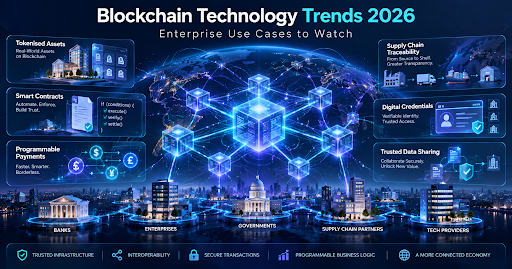
Blockchain is entering a more pragmatic phase of enterprise adoption in 2026. The technology is increasingly being evaluated not for its novelty, but for its ability to reduce reconciliation, establish verifiable records across organisational boundaries, automate multi-party transactions and create programmable forms of ownership.
This marks an important change in the enterprise conversation. Earlier blockchain initiatives frequently began with the technology and then searched for a use case. The more credible deployments now begin with a business problem: several parties maintain separate records, trust is fragmented, verification is expensive, settlement is slow, or compliance requires repeated reconciliation.
The World Economic Forum describes 2026 as an inflection point at which blockchain is increasingly becoming infrastructure as digital-asset initiatives move from experimentation towards enterprise-grade deployment. At the same time, central banks and international institutions are focusing more closely on tokenisation, programmable settlement and interoperable digital financial infrastructure.
The significance of blockchain technology trends 2026 therefore lies less in the expansion of cryptocurrency markets and more in the growing use of distributed ledgers as shared infrastructure for assets, transactions, credentials and trusted data exchange.
For technology professionals looking to build deeper expertise in this space, an M.Tech Blockchain and Big Data course can provide a structured pathway to understand distributed systems, data architecture, enterprise blockchain applications and the broader infrastructure supporting trusted digital transactions.
Blockchain is most useful when several independent participants need to rely on the same information but no single participant can efficiently own or control the entire record.
That requirement appears in many sectors.
A manufacturer may need suppliers, logistics providers and distributors to verify product provenance. A bank may need multiple institutions to coordinate the issuance, transfer and settlement of an asset. A government agency may need credentials to be independently verifiable across jurisdictions. An insurer may require tamper-evident records from several organisations before validating a claim.
In each case, the business problem is not simply data storage. Conventional databases already perform that function effectively.
The differentiating requirement is shared trust across organisational boundaries.
This distinction provides a useful test for enterprise adoption:
Blockchain becomes relevant when the cost of coordinating trust between independent parties is greater than the cost of operating a shared digital infrastructure.
That principle separates economically meaningful implementations from technology-led experimentation.
Tokenisation has become one of the clearest institutional applications of distributed ledger technology.
A tokenised asset represents ownership or a financial claim digitally on programmable infrastructure. Securities, bonds, funds, deposits and other financial instruments can potentially be issued, transferred and settled within the same digital environment.
The IMF noted in July 2026 that tokenisation is gaining momentum in financial markets and could have significant implications for market structure, risk management and financial stability. Its analysis distinguishes three interconnected layers: infrastructure, tokenised assets and the services that operate around them.
Europe provides evidence of the transition from pilots towards operational experimentation. The European Central Bank reported in 2026 that European issuers had placed close to €4 billion in DLT-based fixed-income instruments since 2021, alongside approximately €1.6 billion in Eurosystem exploratory transactions during 2024.
The enterprise opportunity extends beyond digitising an existing security. Tokenisation can potentially combine issuance, ownership records, settlement instructions and programmable conditions within a more integrated architecture.
The strategic challenge is interoperability. A tokenised market fragmented across incompatible platforms could recreate many of the inefficiencies that the technology was intended to remove.
Traditional payment systems typically separate commercial logic from financial settlement.
A transaction may require a contract to be checked, an invoice approved, payment initiated, reconciliation completed and records updated across several systems.
Programmable infrastructure can compress parts of this sequence.
Smart contracts can execute predefined conditions automatically, potentially allowing payments to be linked directly to delivery milestones, collateral movements, trade documentation or other verifiable events.
The Bank for International Settlements has highlighted programmable payments as one of the possibilities created by tokenisation while emphasising that technological innovation must remain anchored in robust institutional arrangements and trusted forms of money.
The enterprise value lies in reducing the separation between transaction logic and settlement.
This could become especially relevant in treasury, wholesale payments, cross-border settlement, trade finance and complex commercial contracts.
Supply chains illustrate one of the most intuitive applications of shared ledgers.
Products frequently pass through manufacturers, suppliers, logistics operators, distributors, retailers, certification organisations and regulators. Each participant may maintain separate records, creating gaps in visibility and opportunities for inconsistency.
Blockchain can support a common audit trail of product events while allowing independent organisations to verify provenance and transaction history.
GS1 notes that blockchain networks can use global identification and structured-data standards to establish a shared version of supply-chain events while reducing data duplication and reconciliation. Standards such as EPCIS allow organisations to exchange event-level information across enterprises using a common structure.
The strongest use cases are likely to occur where provenance carries economic or regulatory importance—for example:
The value proposition is consequently moving beyond tracking a shipment towards proving what happened to a product, where it originated and whether required standards were followed.
The same infrastructure used for traceability can also address authenticity.
Counterfeit products create problems not only for consumer brands but also for healthcare, manufacturing, aerospace, automotive components and regulated supply chains.
Blockchain-based product credentials can create a verifiable record linking an item to its manufacturer, certifications, production events and ownership history.
The European Blockchain Services Infrastructure identifies verification of product authenticity and provenance as a specific application, allowing product-related information to be validated through decentralised infrastructure across the lifecycle of a good.
This model becomes particularly relevant as physical products increasingly acquire digital identities through QR codes, NFC tags, connected sensors or digital-product-passport frameworks.
Blockchain does not independently prove that physical information entered into a system is accurate. However, it can make the provenance and subsequent alteration of that information considerably easier to verify.
That distinction is critical for enterprise adoption.
Digital identity is developing into another important enterprise use case.
Organisations continuously verify qualifications, licences, company registrations, supplier credentials, employee identities and professional certifications.
Many of these processes still depend on central databases, scanned documents or repeated verification with issuing institutions.
Distributed identity models allow trusted organisations to issue digitally verifiable credentials that can subsequently be authenticated without repeatedly contacting the original issuer.
The European Commission's EBSI infrastructure, for example, supports verification of credentials belonging both to individuals and legal entities, including diplomas, professional certificates, company information and institutional accreditations.
The commercial implications extend into:
The emerging opportunity is less about placing personal information directly on a blockchain and more about using distributed trust infrastructure to verify whether a credential is authentic.
Trade finance remains a highly document-intensive area involving banks, importers, exporters, shipping companies, insurers, customs authorities and other intermediaries.
Each party may maintain separate versions of documentation and transaction status.
This makes trade finance structurally suitable for distributed infrastructure, provided legal recognition, interoperability and governance are sufficiently mature.
A shared ledger can potentially connect documentation, financing, shipment events and payment conditions while smart contracts automate certain predefined actions.
The underlying advantage is straightforward: when multiple parties currently reconcile the same transaction repeatedly, a mutually trusted transaction record can reduce administrative friction.
However, enterprise adoption depends on much more than implementing blockchain software. Digital documentation standards, jurisdictional recognition, banking integration and participant adoption determine whether a platform creates genuine network value.
Smart contracts are often described as self-executing agreements, but their enterprise significance is better understood as programmable transaction logic.
They allow predefined business conditions to trigger actions automatically.
Possible applications include:
The important development in 2026 is the growing focus on how these systems interact with governance and legal accountability.
The European Blockchain Regulatory Sandbox explicitly addresses issues including smart contracts, liability, data protection, cybersecurity, consumer protection and sector-specific regulations.
This reflects an essential enterprise reality: code may automate execution, but organisations remain responsible for determining what happens when underlying data is wrong, contractual conditions conflict or exceptional circumstances require intervention.
Data sharing between organisations is becoming increasingly important as AI, connected devices and digital ecosystems depend upon information from multiple sources.
Yet organisations frequently hesitate to exchange sensitive data because they cannot easily verify provenance, permissions or subsequent usage.
Blockchain can provide a trust layer around these exchanges without necessarily storing all underlying data directly on-chain.
The European Commission identifies trusted data sharing as one of the applications of distributed ledger infrastructure, including cross-border information exchange between public authorities. EBSI also supports track-and-trace and credential models that allow participants to verify data or entities without depending on a single central database.
Potential enterprise applications include regulated data exchanges, industrial ecosystems, sustainability reporting and multi-company AI data environments.
The critical design question is deciding what belongs on the ledger and what should remain within conventional databases or protected data environments.
This convergence of distributed ledgers and enterprise data systems is also making interdisciplinary learning more relevant. An Online M.Tech Blockchain programme can help professionals understand how blockchain architecture interacts with data engineering, cloud systems, privacy controls and emerging digital ecosystems.
Financial markets do not end once an asset is issued.
Assets need to be transferred, collateralised, reconciled, reported and serviced throughout their lifecycle.
Tokenised infrastructure creates the possibility of automating some of these processes using shared records and programmable rules.
An IMF working paper published in 2026 examined how DLT could allow smart contracts to perform functions traditionally associated with financial-market infrastructure, including record-keeping, settlement, collateral management and reporting. It also emphasised that governance, legal certainty, discretion and accountability remain institutional responsibilities.
This distinction is likely to shape enterprise adoption.
The most viable blockchain models may not eliminate institutions. Instead, they may automate selected processes while preserving institutional accountability around them.
Public-sector initiatives provide an important indicator of technological maturity because government applications require interoperability, regulatory alignment, identity frameworks and long-term governance.
The European Blockchain Services Infrastructure was established through cooperation between EU Member States, Norway, Liechtenstein and the European Commission. Its use cases encompass verifiable credentials, organisational verification and product traceability, with governance evolving towards production deployment.
Such infrastructure demonstrates that blockchain adoption is no longer limited to speculative digital assets.
Government-backed distributed infrastructure can provide trusted digital rails on which private organisations subsequently build services.
The strategic implication for enterprises is that blockchain could increasingly become part of wider digital-public-infrastructure ecosystems rather than remaining a standalone corporate technology project.
Not every multi-party process requires a blockchain.
A useful decision framework is the Enterprise Blockchain Value Matrix, which evaluates a potential implementation across four dimensions.
| Dimension | Low Blockchain Relevance | High Blockchain Relevance |
|---|---|---|
| Number of Independent Parties | One organisation controls the process | Several organisations must coordinate |
| Trust Structure | A trusted central authority already exists | Participants require independent verification |
| Reconciliation Burden | Records are already synchronised | Different parties maintain conflicting copies |
| Programmability Requirement | Transactions are simple and manual | Conditional execution can automate substantial work |
A potential blockchain project becomes stronger when it scores highly across several dimensions simultaneously.
For example, an internal employee database normally has little reason to use distributed ledger technology because one organisation already controls the record.
Cross-border trade documentation is different. Multiple organisations participate, records must be reconciled, no single commercial participant necessarily controls the entire transaction and predefined events can trigger financial actions.
This leads to a broader principle:
Blockchain is most valuable when it replaces duplicated trust infrastructure, not when it merely replaces a database.
For professionals evaluating an M.Tech Blockchain and Big Data course, this distinction is important. The strongest programmes should go beyond blockchain implementation and develop the ability to evaluate when distributed architecture creates genuine business and technical value.
The maturity of the enterprise blockchain use cases varies considerably. Tokenised financial instruments and programmable settlement are advancing through institutional pilots and production initiatives; credential verification and traceability have clear cross-organisational applications; while some fully decentralised business models remain dependent on unresolved governance, interoperability and regulatory questions.
A comparative view helps distinguish technological possibility from organisational readiness.
| Use case | Primary enterprise value | Key adoption requirement |
|---|---|---|
| Tokenised assets | Faster and more programmable financial infrastructure | Regulation and settlement interoperability |
| Programmable payments | Automated conditional transactions | Trusted settlement assets |
| Supply-chain traceability | Shared provenance and auditability | Common data standards |
| Product authenticity | Counterfeit detection and lifecycle verification | Reliable physical-to-digital linkage |
| Digital credentials | Faster verification of trusted information | Identity and credential standards |
| Trade finance | Reduced document reconciliation | Multi-party participation |
| Smart contracts | Automated transaction logic | Legal and governance frameworks |
| Trusted data sharing | Verifiable cross-organisational information | Privacy and access controls |
| Collateral management | More integrated asset servicing | Market-infrastructure integration |
| Public digital infrastructure | Cross-border trusted services | Long-term institutional governance |
Technology maturity alone will not determine the trajectory of enterprise blockchain.
Three other conditions are likely to matter more.
Enterprises rarely operate within one technology ecosystem. Blockchain networks must therefore interact with conventional databases, cloud environments, payment infrastructure, identity systems and other distributed networks.
The European Commission explicitly identifies interoperability as essential to the success of blockchain and Web3 infrastructure.
A decentralised ledger does not remove the requirement for governance.
Organisations still need rules governing membership, software upgrades, disputes, errors, cybersecurity, permissions and legal accountability.
The Bank of Italy's 2026 assessment of DLT adoption similarly emphasised that governance, formal legal frameworks, compliance and risk management remain essential even as production-grade blockchain projects develop.
Professionals considering M.Tech Blockchain admission should therefore assess whether the curriculum addresses not only distributed ledger technologies, but also interoperability, governance, enterprise integration, data systems, cybersecurity and regulatory considerations.
A blockchain implementation must provide measurable benefits over conventional architecture.
Those benefits could include lower reconciliation costs, faster settlement, reduced fraud, improved traceability, automated compliance or new forms of asset liquidity.
Without a meaningful economic advantage, decentralisation alone is not a sufficient reason for deployment.
Several lessons from the earlier generation of blockchain experimentation remain relevant.
The appropriate question is therefore not whether an organisation can deploy blockchain.
It is whether blockchain creates a better trust architecture for a specific business process.
The most important blockchain development in 2026 may be its gradual disappearance as a headline technology.
As successful implementations mature, users may increasingly interact with tokenised securities, verified credentials, product provenance systems or programmable payments without needing to think about the distributed ledger underneath them.
This is characteristic of infrastructure technologies.
The internet became valuable when organisations stopped treating connectivity itself as the product and began building business processes on top of it. Cloud computing became mainstream when enterprises focused less on virtualisation technology and more on the applications and operating models it enabled.
Blockchain may be approaching a similar test.
This evolution also changes what advanced blockchain education needs to deliver. An Online M.Tech Blockchain pathway should increasingly prepare professionals to think in terms of enterprise architecture, data systems, programmability and cross-organisational trust rather than blockchain platforms in isolation.
Its long-term enterprise relevance will depend not on how many organisations claim to use blockchain, but on whether distributed infrastructure can make transactions, assets and information more trustworthy, programmable and efficient than the systems it replaces.
Tokenised financial assets, programmable payments, supply-chain traceability, verifiable credentials, digital product authentication, trade finance and smart-contract automation are among the more significant applications. Their maturity differs considerably, and adoption generally depends on interoperability, governance and regulatory clarity.
No. Cryptocurrency is one application of blockchain-based infrastructure. Enterprise implementations may instead use distributed ledgers for tokenised securities, credentials, product provenance, settlement, data verification or transaction automation without using public cryptocurrencies.
A traditional database is generally more appropriate when a single organisation controls the process. Blockchain becomes more relevant when several independent organisations need to share, verify and update records without relying entirely on one participant as the central authority.
Interoperability, regulation, governance, integration with existing enterprise systems, privacy, data quality and the difficulty of creating sufficient participation across a business network remain major challenges. Technical feasibility alone does not guarantee commercial viability.
A wholesale replacement is unlikely in most environments. Blockchain is more likely to operate alongside ERP systems, databases, cloud platforms, payment networks and identity infrastructure, providing a shared trust or transaction layer where cross-organisational coordination creates sufficient value.
An M.Tech Blockchain and Big Data course can help professionals develop deeper knowledge of distributed systems, data engineering, blockchain architecture, enterprise integration, security and emerging digital infrastructure. Its value is strongest when the curriculum connects technology concepts with real enterprise use cases.
Professionals evaluating an Online M.Tech Blockchain programme should look for coverage across distributed ledger architecture, smart contracts, data systems, interoperability, security, cloud integration and enterprise applications. A strong programme should develop architectural understanding rather than focus only on individual blockchain platforms.
Professionals considering M.Tech Blockchain admission should evaluate the programme's curriculum depth, eligibility requirements, learning format, faculty expertise and relevance to enterprise blockchain and data-driven roles. The published programme page should be used to confirm current admission requirements and eligibility criteria.