

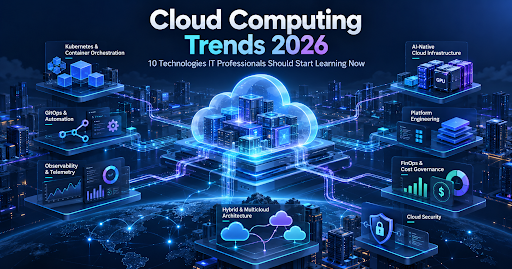
Cloud computing in 2026 is entering a markedly different phase from the migration-led era that shaped the previous decade. The dominant question is no longer whether enterprises will use cloud infrastructure. It is how they will operate increasingly distributed, AI-intensive, automated and regulated technology estates without losing control over cost, security, performance or developer productivity.
That distinction matters for technology professionals. Cloud expertise is moving beyond familiarity with infrastructure services towards a broader understanding of orchestration, platform engineering, observability, AI infrastructure, cost governance, security and workload portability.
The scale of this transition is already visible. The Cloud Native Computing Foundation reported in January 2026 that 98% of surveyed organisations had adopted cloud native techniques, while 82% of container users were running Kubernetes in production. Among organisations hosting generative AI models, 66% were using Kubernetes to manage at least part of their inference workloads.
For IT professionals, the significance of the Cloud computing trends 2026 lies in this convergence. Cloud architecture is becoming the operating layer for applications, data, AI workloads, automation and increasingly autonomous systems. The most relevant capabilities are therefore those that help technology teams build, govern and operate this converged environment.
For professionals considering structured advanced education alongside their careers, an M.Tech Cloud Computing pathway can provide a broader academic framework for engaging with these evolving areas of cloud architecture, infrastructure automation, security and distributed systems.
Earlier generations of cloud architecture were often organised around three questions: where an application should run, how much infrastructure it needed and which services should support it.
That model is expanding.
Modern technology estates may now involve public cloud, private infrastructure, edge environments, container platforms, GPU clusters, SaaS applications, AI models, distributed data stores and multiple security domains simultaneously. The challenge is no longer simply provisioning infrastructure. It is coordinating these layers as one operating environment.
CNCF and SlashData's 2026 research found that hybrid cloud had become the dominant deployment model, while 88% of backend developers were operating in standardised DevOps or platform environments.
This creates a useful way to think about professional development: not as a list of individual tools, but as a sequence of capabilities required to make complex infrastructure dependable.
Kubernetes has moved considerably beyond its original role as a container orchestration platform.
It is increasingly becoming a common infrastructure layer for conventional applications, databases, AI inference and distributed computing. The CNCF Annual Cloud Native Survey found that Kubernetes production usage among container users increased from 66% in 2023 to 82% in 2025.
The more consequential development is its growing role in AI infrastructure.
AI systems create requirements that conventional applications do not always share: GPU scheduling, large model artefacts, inference routing, accelerator allocation and workload-specific scaling. Kubernetes is evolving to accommodate these needs through capabilities such as Dynamic Resource Allocation and specialised inference routing.
For IT professionals, Kubernetes competence increasingly requires more than knowing how to deploy containers. Relevant areas include cluster architecture, networking, storage, autoscaling, security policies, workload scheduling and resource governance.
The complexity created by cloud native architectures has produced a second major shift: organisations are building internal platforms so individual application teams do not need to manage infrastructure complexity themselves.
Platform engineering creates standardised paths through which developers can provision infrastructure, deploy applications, apply policies and access approved services.
In March 2026, CNCF research involving more than 400 professional developers found that 28% of organisations had dedicated platform engineering teams, while another 41% used multi-team collaboration to manage platform capabilities. Helm, Backstage and kro were among the technologies placed in the “Adopt” category of the CNCF Technology Radar.
The significance of platform engineering is organisational as much as technical. Mature cloud environments are increasingly being designed as products for internal developers rather than collections of infrastructure components.
Professionals entering this area need an understanding of developer experience, self-service infrastructure, policy automation, service catalogues and reusable deployment patterns.
AI is becoming an infrastructure problem as much as a modelling problem.
Once AI moves from experimentation to production, technology teams must manage inference latency, model availability, GPU utilisation, model versions, scaling, security and observability.
CNCF research indicates that while infrastructure adoption is accelerating, operational maturity is still developing. Only 7% of organisations surveyed were deploying AI models daily, while 47% deployed them occasionally.
This gap between experimentation and production is creating a new professional domain: AI infrastructure engineering.
Skills are beginning to span model serving, GPU orchestration, inference gateways, workload scheduling, vector infrastructure, AI observability and infrastructure economics.
The implication is important. AI capability will not reside exclusively with data scientists. Cloud architects, DevOps specialists, SREs and platform engineers will increasingly be responsible for the systems that allow AI to operate reliably at enterprise scale.
Infrastructure automation is moving towards systems in which the desired state of infrastructure and applications is defined declaratively and reconciled automatically.
GitOps extends software engineering practices such as version control, peer review and automated deployment into infrastructure operations.
Its growing importance is closely associated with cloud native maturity. CNCF reported that 58% of organisations classified as cloud native innovators used GitOps principles extensively, compared with 23% among adopters.
Tools such as Argo CD and Flux are relevant, but the larger capability is understanding declarative operations.
For professionals, this means becoming comfortable with infrastructure-as-code, configuration management, pull-based deployment, policy enforcement and automated reconciliation.
The broader direction is clear: manually administered cloud estates are becoming increasingly difficult to govern at scale.
Distributed cloud environments are extremely difficult to operate without visibility across applications, networks, infrastructure and services.
Observability has consequently moved from operational monitoring towards architecture-level capability.
OpenTelemetry reached CNCF graduated-project status in May 2026, reflecting its maturity as a vendor-neutral framework for collecting and processing metrics, logs and traces. CNCF reported that the project had grown to more than 12,000 contributors from over 2,800 companies.
Its relevance extends beyond conventional applications. AI infrastructure also requires new forms of telemetry around inference performance, accelerator utilisation, token throughput, latency and reliability.
Professionals therefore need to understand not simply monitoring dashboards but instrumentation, traces, metrics, logs, telemetry pipelines, service-level objectives and distributed-system diagnosis.
Observability is increasingly becoming the language through which complex technology estates explain their behaviour.
Cloud computing separated infrastructure consumption from traditional fixed-capacity procurement. AI is now magnifying the financial consequences of that shift.
GPU infrastructure, model inference, SaaS platforms, storage and distributed workloads can create rapidly changing technology costs. This is making FinOps relevant beyond finance teams.
The FinOps Foundation's 2025 State of FinOps research, covering organisations responsible for more than US$69 billion in cloud spend, found that 63% of respondents were already managing AI spending through FinOps practices, up from 31% the previous year.
For technology professionals, this creates a new expectation: architecture decisions increasingly need to incorporate economics.
Relevant knowledge areas include resource utilisation, workload unit economics, tagging, allocation, forecasting, commitment management and cost-performance trade-offs.
A cloud engineer who understands technical performance but not the economics of infrastructure will increasingly be operating with only part of the architectural picture.
Conventional cloud security has historically concentrated heavily on protecting data at rest and in transit.
Confidential computing addresses another state: data while it is actively being processed.
It uses hardware-based trusted execution environments to isolate workloads and protect information during computation. The relevance is increasing as organisations place sensitive analytical and AI workloads on shared or third-party infrastructure.
In July 2026, Confidential Containers became a CNCF incubating project. The initiative applies trusted execution environments to containerised workloads so that data in use can remain protected from underlying infrastructure operators.
The technology is particularly relevant to regulated industries, sensitive datasets, multi-party computing and AI workloads involving confidential information.
Cloud security professionals should therefore become familiar with attestation, trusted execution environments, workload isolation, confidential virtual machines and hardware-rooted trust.
As cloud native systems become more distributed, traditional approaches to network monitoring and security can struggle to provide sufficient visibility.
Extended Berkeley Packet Filter, or eBPF, allows programmes to execute safely within the Linux kernel, enabling deep visibility into networking, system behaviour and workloads without requiring extensive modification to applications.
Its importance is increasing across cloud native networking, security enforcement and observability. CNCF's 2026 North America programme highlighted eBPF alongside technologies such as Cilium and OpenTelemetry in discussions around identity, runtime protection and distributed cloud security.
For professionals working with Kubernetes, cloud networking, SRE or cybersecurity, eBPF is becoming increasingly relevant because it provides visibility close to the operating-system layer.
The value is not merely learning a new technology. It is understanding how kernel-level telemetry and policy can improve control over increasingly ephemeral infrastructure.
Cloud strategy is becoming less synonymous with moving everything into one public cloud environment.
Hybrid deployment models are increasingly common, particularly where organisations have requirements involving latency, regulation, legacy infrastructure, data residency or specialised computing resources.
India offers a particularly relevant example. CNCF's State of Cloud Native Development in India 2026 estimated that 2.25 million developers in the country were cloud native and reported that hybrid cloud adoption had reached 44%, making it the most widely used deployment model among surveyed Indian developers.
Sovereign infrastructure is adding another dimension. Regulatory and national requirements can determine where data is stored, who operates infrastructure and which jurisdictions exercise control over technology systems. Microsoft, for example, expanded its sovereign private-cloud architecture in 2026 to support large local deployments across datacentres, industrial environments and edge locations.
Professionals increasingly need to understand portability, distributed identity, data locality, multicluster management and the trade-offs between centralisation and sovereignty.
Cloud security is entering a different phase because software systems are becoming more autonomous.
Traditional applications largely execute predetermined logic. Agentic AI systems can take actions dynamically, interact with tools, access services and communicate across systems.
This changes the security model.
Identity becomes critical not only for employees and applications but also for workloads, APIs, agents and machine-to-machine interactions. Runtime policies, short-lived credentials, software supply-chain integrity and zero-trust architecture consequently become more important.
CNCF's 2026 cloud native security agenda increasingly reflects these concerns, with emphasis on workload identity, authorisation frameworks, stronger isolation, confidential computing and policy enforcement for automated environments.
Professionals preparing for this environment should understand zero trust, workload identity, policy-as-code, software supply-chain security, secrets management and runtime protection.
The ten technologies do not have equal learning priority for every IT professional.
A useful way to organise them is through the Cloud Capability Horizon, which separates skills according to how broadly they apply and how specialised their use cases currently remain.
| Capability horizon | Technologies | Professional relevance |
|---|---|---|
| Core Infrastructure | Kubernetes, GitOps, hybrid cloud | Essential for operating modern distributed infrastructure |
| Operational Intelligence | OpenTelemetry, FinOps, eBPF | Improves visibility, efficiency and control |
| Developer Infrastructure | Platform engineering | Standardises how technology teams consume cloud services |
| AI Infrastructure | AI-native cloud architecture | Supports model deployment, inference and accelerator-intensive workloads |
| Trust Infrastructure | Confidential computing, cloud-native security | Protects sensitive and increasingly autonomous systems |
| Strategic Architecture | Sovereign and multicloud design | Addresses regulatory, geographic and enterprise resilience requirements |
The model provides an important distinction: cloud professionals do not necessarily need expert-level knowledge across every domain.
Architects may require greater depth in hybrid design and sovereignty. SREs may prioritise observability and eBPF. DevOps professionals may benefit more immediately from GitOps and platform engineering. Security professionals may concentrate on workload identity and confidential computing.
The strongest learning strategy is therefore role-specific rather than tool-driven.
This role-specific approach can also help professionals evaluate an Online M.Tech Cloud Computing programme more effectively - by looking beyond individual tools and considering whether the curriculum develops capabilities across infrastructure, automation, observability, security, AI systems and cloud architecture.
The cloud computing skills in demand 2026 are becoming combinations of capabilities rather than isolated certifications. Employers increasingly require professionals who understand how orchestration affects security, how architecture affects cost, how observability affects reliability and how AI changes infrastructure requirements.
This is an important departure from the earlier cloud era, when proficiency with a specific provider's services could be sufficient differentiation.
Modern infrastructure increasingly rewards transferable architectural understanding.
An engineer who understands container orchestration, identity, networking, telemetry, automation and cost governance can apply those principles across multiple environments. The specific implementation may change, but the infrastructure reasoning remains valuable.
India's large technology-services ecosystem makes this evolution particularly significant.
The country's cloud native developer base is now one of the largest globally. CNCF and SlashData estimated 2.25 million cloud native developers in India in 2026, within a global population of approximately 19.9 million.
The next opportunity therefore extends beyond helping enterprises migrate workloads.
Indian technology professionals are increasingly positioned to design platforms, operate AI infrastructure, engineer multicloud systems, implement observability, govern infrastructure expenditure and build secure distributed systems for global organisations.
This shifts the professional value proposition from cloud implementation towards cloud architecture and operational intelligence.
Attempting to learn every emerging cloud technology simultaneously is rarely effective.
A more disciplined sequence would be:
This sequence reflects an important principle: emerging technology skills become more valuable when they are built on infrastructure fundamentals rather than learned as isolated products.
For experienced technology professionals seeking deeper academic progression, an M.Tech in Cloud Computing can therefore be viewed as part of a longer capability-building journey rather than simply as preparation for a particular cloud platform or certification.
The cloud profession is not becoming obsolete as managed services and automation expand.
It is becoming more architectural.
Every layer abstracted by a platform creates another layer that someone must understand, govern and optimise. AI increases compute complexity. Hybrid environments increase operational complexity. Regulation increases architectural constraints. Automation increases the importance of policy. Distributed applications increase the need for observability.
The professional requirement is therefore shifting from knowing how to provision infrastructure towards understanding how complex digital systems behave.
That shift is also changing the value of advanced technology education. Professionals evaluating an Online M.Tech Cloud Computing pathway should increasingly look for depth across architecture, distributed systems, automation, AI infrastructure, security and operational decision-making rather than cloud administration alone.
The cloud professionals most prepared for the next phase will be those who can connect infrastructure, software delivery, AI, security, reliability and economics into one coherent operating model.
That is the defining cloud capability of 2026.
Yes. Kubernetes has moved beyond being an emerging container technology and has become a foundational layer for modern cloud native infrastructure. Its growing use for AI inference, data-intensive workloads and enterprise platforms makes Kubernetes knowledge relevant across cloud engineering, DevOps, SRE and platform-engineering roles.
The appropriate starting point depends on existing experience. Professionals new to cloud infrastructure generally benefit from developing competence in Linux, networking, containers and infrastructure automation before moving into Kubernetes, GitOps or specialised areas such as AI infrastructure.
AI is more likely to change cloud-engineering responsibilities than remove the need for them. Production AI systems require infrastructure for accelerator scheduling, inference, storage, networking, security, observability and cost management. These requirements are expanding the scope of cloud and platform engineering.
Provider-specific expertise remains valuable, but understanding portable architectural concepts is increasingly important. Hybrid and multicloud environments require professionals to reason across networking, identity, orchestration, security, observability and workload portability rather than depending exclusively on one provider's services.
Security is becoming integral to cloud architecture rather than a separate operational function. Workload identity, zero-trust principles, software supply-chain security, confidential computing and runtime policy are becoming increasingly important as cloud systems grow more distributed and autonomous.
An M.Tech Cloud Computing programme can help professionals develop structured knowledge across areas such as cloud architecture, distributed systems, infrastructure automation, security, networking and emerging AI infrastructure. Its relevance increasingly depends on how effectively the curriculum connects foundational computing concepts with contemporary cloud engineering practices.
Professionals considering an Online M.Tech Cloud Computing programme should evaluate the depth of its curriculum across cloud architecture, containers, automation, networking, security, distributed systems, observability and emerging AI infrastructure. The programme should support broader architectural understanding rather than focus only on individual cloud tools or certifications.