

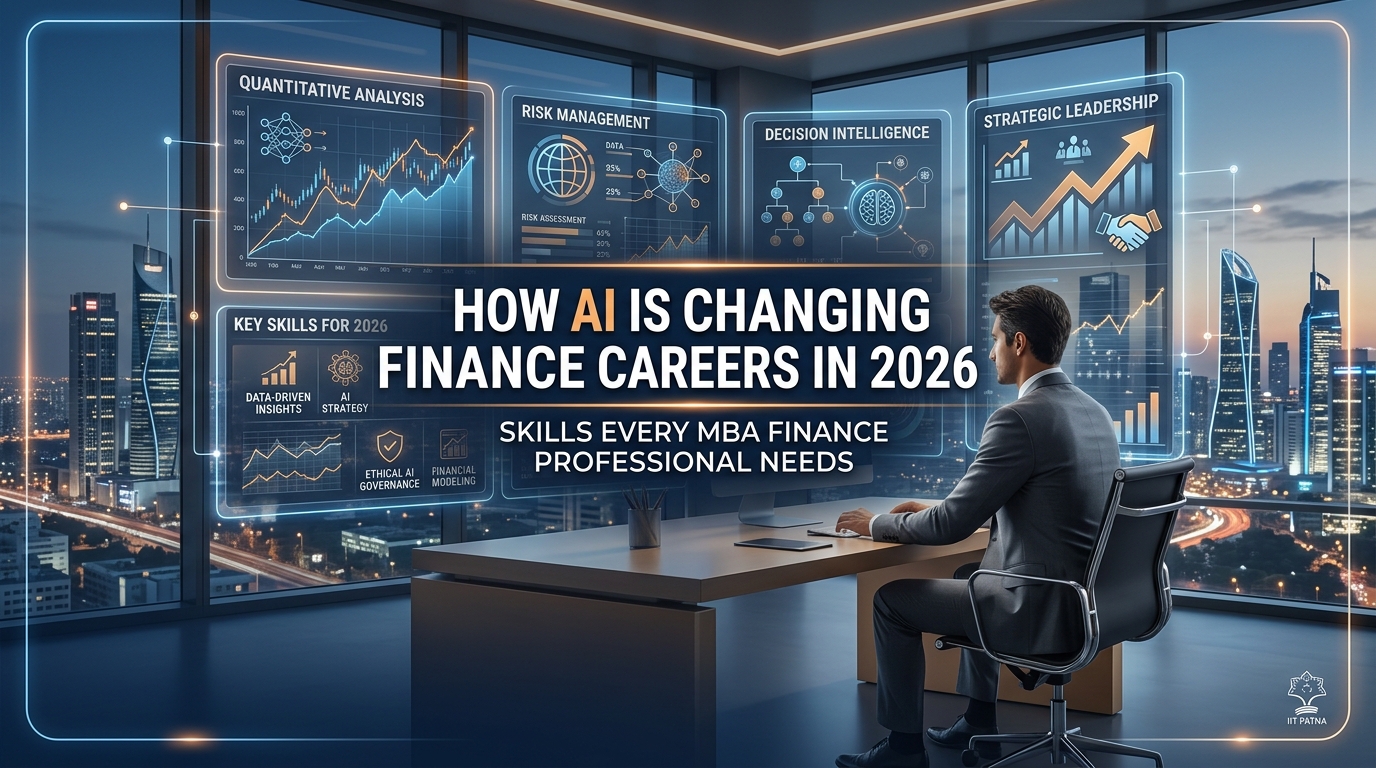
Artificial intelligence is changing finance less by eliminating the need for financial expertise and more by changing where that expertise creates value. In 2026, routine analysis, data reconciliation, variance identification, reporting support and parts of forecasting can increasingly be accelerated by AI-enabled systems. As these activities become faster, the premium is shifting towards professionals who can interrogate outputs, connect financial signals with business context, evaluate risk and translate analysis into decisions.
This transition is visible across finance organisations. Deloitte's Finance Trends 2026 research reports that 63% of surveyed finance teams have fully deployed and are actively using AI solutions, while 14% are already using fully integrated AI agents. At the same time, 64% of finance leaders surveyed said they intended to prioritise AI, automation and data-analysis capabilities over traditional skillsets when developing their teams.
The implication for finance professionals is significant. Technical finance knowledge remains fundamental, but its application is changing. Professionals are increasingly expected to operate at the intersection of finance, technology, data, strategy and governance.
Historically, a substantial part of finance work centred on producing information: closing books, consolidating reports, building spreadsheets, calculating variances and preparing management packs. Increasingly capable automation and AI systems can now assist with many of these activities.
The resulting shift can be described as a movement from information production to decision architecture.
Instead of asking only whether financial information has been prepared correctly, organisations increasingly need professionals who can determine:
This helps explain why MBA Finance career opportunities in 2026 are likely to be shaped not simply by conventional job titles but by the degree of judgement, analytical depth and cross-functional responsibility embedded within a role. Financial planning and analysis, corporate finance, treasury, risk, controllership, investment analysis, business finance, fintech and strategic finance are all being influenced by the same underlying transition: machines can process more information, while professionals are expected to make better decisions from it.
The impact of AI is uneven because financial work contains different kinds of tasks.
Highly standardised work with defined rules is comparatively easier to automate. Activities requiring contextual judgement, accountability or interpretation remain considerably more dependent on human expertise.
| Finance activity | Growing role of AI | Continuing human responsibility |
|---|---|---|
| Transaction processing | Classification, matching and exception identification | Policy interpretation and exception resolution |
| Financial reporting | Drafting summaries and detecting anomalies | Materiality judgement and narrative interpretation |
| Forecasting | Pattern detection and scenario generation | Assumption validation and commercial judgement |
| FP&A | Variance analysis and modelling support | Strategic recommendation and resource allocation |
| Risk management | Large-scale pattern and anomaly detection | Risk appetite, escalation and governance |
| Investment analysis | Rapid document and data analysis | Thesis formation, valuation judgement and conviction |
| Treasury | Cash forecasting and liquidity signals | Funding strategy and counterparty decisions |
| Audit and controls | Continuous monitoring and exception detection | Control design, investigation and accountability |
The distinction matters because discussions about AI in finance careers can become overly focused on whether particular jobs will disappear. A more useful question is which components of each role are becoming machine-assisted and which components consequently become more valuable. The evidence increasingly points towards task reconfiguration rather than a uniform replacement of finance occupations. PwC's 2026 analysis found that financial services had the second-highest rate of net skills change among the sectors examined, indicating substantial restructuring of the capabilities expected within existing roles.
AI can generate an answer quickly. Finance professionals still carry responsibility for determining whether the answer deserves to influence a business decision.
This creates an important distinction between AI capability and AI judgement.
An AI system may identify an unexpected decline in gross margin. A finance professional must determine whether the change reflects pricing, product mix, procurement costs, channel economics, inventory treatment, currency movements or an accounting anomaly.
An AI-generated forecast may project strong revenue growth. Management still requires someone to question whether the forecast incorporates customer concentration, competitive pressure, working-capital requirements, capacity constraints or changes in market demand.
The greater the analytical capacity of technology, therefore, the more consequential validation becomes.
This is consistent with broader labour-market evidence. The World Economic Forum identifies AI and big data among the fastest-growing skills, while analytical thinking remains the most widely demanded core skill among surveyed employers. Leadership, technological literacy, resilience and creative thinking also remain prominent.
A useful way to understand the changing professional requirements is through the Finance Intelligence Stack, a five-layer capability model for AI-enabled finance roles.
Accounting, corporate finance, financial statements, valuation, taxation, capital structure, economics and risk remain the base of the profession.
AI does not reduce the importance of these disciplines. It increases the danger of using financial outputs without understanding how they were constructed.
Finance professionals increasingly require the ability to work across structured and unstructured information, recognise data-quality issues, interpret analytical outputs and understand how datasets influence conclusions.
This does not mean every finance professional must become a data scientist. It does mean that data literacy is becoming inseparable from financial literacy.
Professionals need to understand where AI tools can accelerate research, analysis, forecasting, scenario modelling, reporting and exception management—and where their outputs require verification.
Effective AI use in finance therefore includes prompt formulation, output validation, model limitations, source verification and responsible handling of confidential information.
Financial analysis creates value only when connected with the economics of the organisation.
This layer includes pricing, customer economics, unit economics, investment trade-offs, profitability, competitive dynamics, capital allocation and scenario evaluation.
At the highest level, finance professionals must communicate recommendations, challenge assumptions, influence stakeholders and balance growth, returns and risk.
AI can strengthen the evidence available to decision-makers. It cannot assume accountability for the decision itself.
Together, the five layers explain why the strongest finance professionals of the AI era are unlikely to be defined either as purely financial specialists or purely technology specialists. Their advantage will come from connecting both disciplines to business judgement.
The MBA Finance skills in demand in 2026 can therefore be understood through seven interconnected capabilities rather than through individual software tools.
Professionals need sufficient understanding of AI-enabled systems to use them intelligently, recognise inappropriate outputs and participate meaningfully in technology-led finance transformation.
As routine calculations become easier to automate, the ability to interpret relationships between profitability, cash flow, leverage, working capital, return on capital and business performance becomes more important.
Static budgeting is increasingly inadequate in volatile operating environments. Finance teams require professionals capable of modelling multiple futures, identifying leading indicators and evaluating alternative management responses.
Modern finance increasingly operates alongside sales, operations, technology, product, supply chain and leadership teams. Professionals must understand the economic consequences of operating decisions rather than remain confined to financial reporting.
The adoption of AI introduces questions involving model risk, privacy, explainability, cybersecurity, regulatory compliance and internal control.
The World Economic Forum's 2026 AI Playbook for Financial Services identifies governance, data foundations, workforce transformation and AI strategy among the central considerations for institutions moving from experimentation towards scaled adoption.
Senior stakeholders rarely need more data. They require clarity about what the data means, what could happen next and what decision should be considered.
The ability to reduce analytical complexity into a defensible management recommendation is therefore becoming an increasingly valuable finance capability.
Perhaps the most important capability is also among the least technological.
AI makes it possible to produce polished analyses at unprecedented speed. Financial professionals must remain willing to challenge assumptions, trace evidence, test sensitivities and reject outputs that appear plausible but are unsupported.
The adoption trajectory in India requires particular attention because digital infrastructure, financial services innovation, enterprise modernisation and a large professional workforce are converging simultaneously.
Deloitte's India findings from its Asia Pacific CFO research showed that 69% of surveyed CFOs were emphasising workforce upskilling and reskilling for new technologies, while 49% expected generative AI to change finance functions within two years.
For Indian finance professionals, the opportunity therefore extends beyond technology companies or specialised fintech firms. AI-enabled finance capability is becoming relevant across banking, financial services, consulting, manufacturing, consumer businesses, technology services, healthcare, infrastructure and other sectors where finance teams are being asked to contribute more directly to enterprise strategy.
This broadening of the finance mandate is particularly important. The professional opportunity is increasingly connected not merely to operating financial systems but to helping organisations decide where to invest, where to reduce exposure, where margins can improve and where emerging technologies can create measurable economic value.
The changing division of work can be summarised through a simple comparison.
| Earlier source of professional value | Emerging source of professional value |
|---|---|
| Producing reports | Interpreting implications |
| Collecting information | Evaluating information quality |
| Building routine models | Challenging model assumptions |
| Historical variance reporting | Forward-looking scenario analysis |
| Spreadsheet execution | Analytical orchestration |
| Functional finance expertise | Cross-functional commercial understanding |
| Periodic control | Continuous risk oversight |
| Technical accuracy alone | Accuracy combined with judgement |
| Communicating numbers | Influencing decisions through financial evidence |
This is why finance expertise does not become obsolete when AI becomes more capable. Instead, the threshold for valuable expertise rises.
PwC's 2026 Global AI Jobs Barometer found that skills in the most AI-exposed occupations were changing more than twice as quickly as those in the least exposed occupations. It also found strong growth in roles where AI augments professional expertise rather than merely lowering the expertise required to perform a task.
The relevance of a skill can be assessed through four questions:
This produces an important career principle: the safest professional position is not necessarily the work that AI cannot perform today. It is work in which technology increases the amount of analysis available while simultaneously increasing the value of expert judgement.
The changing environment has implications for formal management education as well.
A contemporary MBA in Finance course needs to connect established finance disciplines with the realities of data-rich and increasingly AI-enabled organisations. Financial management, valuation, investment analysis, corporate finance and risk remain fundamental, but their professional application increasingly intersects with analytics, digital systems, strategic decision-making and business transformation.
The educational objective is consequently broader than familiarity with emerging tools. Finance professionals require structured opportunities to understand financial concepts deeply enough to question machine-generated outputs, analyse complex business situations and participate effectively in strategic decisions.
This is particularly relevant for professionals seeking roles in which finance moves closer to enterprise leadership. As automation assumes a larger proportion of execution-intensive work, the differentiation increasingly lies in understanding businesses, interpreting uncertainty and exercising disciplined financial judgement.
The most consequential change created by AI is not simply faster financial analysis.
It is a redistribution of professional responsibility.
When technology can produce forecasts, narratives, scenarios and recommendations rapidly, the value of the professional shifts towards determining which outputs matter, what assumptions they contain, what risks they overlook and what action should follow.
Finance professionals therefore face a paradox. Technology is reducing the amount of effort required to generate analysis while increasing the level of sophistication required to use that analysis responsibly.
The career advantage will belong to professionals who can combine financial depth with technological fluency, commercial understanding, governance awareness and strategic judgement.
AI may increasingly generate the numbers.
The finance professional will increasingly be responsible for understanding their consequences.
AI is more likely to automate or accelerate specific finance tasks than eliminate the need for finance expertise altogether. Transaction-heavy, repetitive and rules-based activities are particularly exposed to automation, while work requiring judgement, interpretation, governance, stakeholder management and business context remains substantially human-led.
Coding can be valuable for certain analytics, quantitative or fintech-oriented roles, but it is not a universal requirement. Broader data literacy, understanding of AI capabilities, financial modelling, analytical thinking and the ability to evaluate technology-generated outputs are likely to be more widely relevant across finance roles.
Financial planning and analysis, controllership, audit, risk, treasury, investment research, banking and corporate finance are all likely to experience significant task-level change. The impact will differ according to the degree of standardisation, data availability and judgement required within each role.
AI systems identify patterns and generate outputs from available information, but they do not eliminate the need to understand accounting treatment, valuation principles, capital allocation, business economics, risk or materiality. Strong financial knowledge enables professionals to determine whether technologically generated analysis is commercially and technically sound.
The strongest preparation combines core financial expertise with analytical thinking, AI and data literacy, scenario analysis, commercial understanding, governance awareness and executive communication. The objective is not to compete with technology on processing speed, but to become more capable of directing, validating and applying technology to consequential financial decisions.